
The 2026 Audit Report
How audit firms are really working with data – and what will define readiness in 2026.
- Executive Summary
- The audit data reality check
- What we consistently see across firms
- Key findings
- What surprised us
- What this means for audit leaders in 2026
- The State of Audit Data in 2026
- Same standards. Very different data realities.
- How audit data is sourced today
- Consistency remains the missing layer
- The cost of inconsistency
- What the data tells us
- Busy Season Pressure Points
- Where time is really lost
- Prep starts earlier, pressure peaks harder
- The hidden time drain in audit delivery
- Why busy season still feels bespoke
- The Automation Gap
- Why tools have not delivered scale
- Task automation vs data standardization
- Where automation breaks at volume
- What actually scales
- Audit Teams vs Audit Data
- The growing capability mismatch
- Where people are doing the wrong work
- Data complexity is outpacing capacity
- Why this is becoming a talent issue
- AI Readiness: Signal vs Noise
- What audit leaders are quietly fixing first
- What “AI-ready data” really means🔎
- Why most firms are underprepared
- The real blockers to AI adoption 🚫
- The 2026 Audit Readiness Framework
- Where firms sit today, and where they are heading
- Stage 1: Reactive
- Stage 2: Stabilizing
- Stage 3: Standardized
- Stage 4: Scalable
- Why most firms stall
- What This Means for Audit Leaders
Executive Summary
The audit data reality check
Audit teams are not struggling because they lack standards. They are struggling because the data arriving at the start of an engagement is still too inconsistent to support a repeatable workflow and because new processes, without the right change management behind them, rarely stick. People revert to what they know.
In 2026, the firms that feel in control will not be the ones with the most tools. They will be the ones with the most consistent, audit-ready inputs across their client portfolio, and the internal culture to maintain them.
What we consistently see across firms
- Data preparation is still the hidden bottleneck. It quietly consumes time that should be spent on risk, judgment, and client insight. No tool fixes this if the process feeding it isn’t consistent.
- Automation exists, but adoption does not. Many teams have automated steps but still rebuild datasets engagement by engagement, because new workflows were introduced without the change management needed to make them stick.
- Busy season pressure starts earlier and peaks harder. Small inefficiencies compound when volume rises, and the impact shows up in review cycles and late nights, not in a single obvious failure.
- Senior time is being spent on junior work. When inputs are inconsistent, experienced staff get pulled into fixing, reconciling, and explaining data instead of leading the audit.
- AI readiness is uneven, and often overstated. Most barriers are not model capability. They are data structure, consistency, traceability, and access, compounded by teams that have never been shown why a better process works or how to sustain it.
- Change management is the missing layer. Process improvements only hold when people understand why they work and feel supported through the transition. Without it, even well-designed frameworks get quietly abandoned for the comfort of same as last year.
Key findings
📝 Manual Data Work Still Dominates
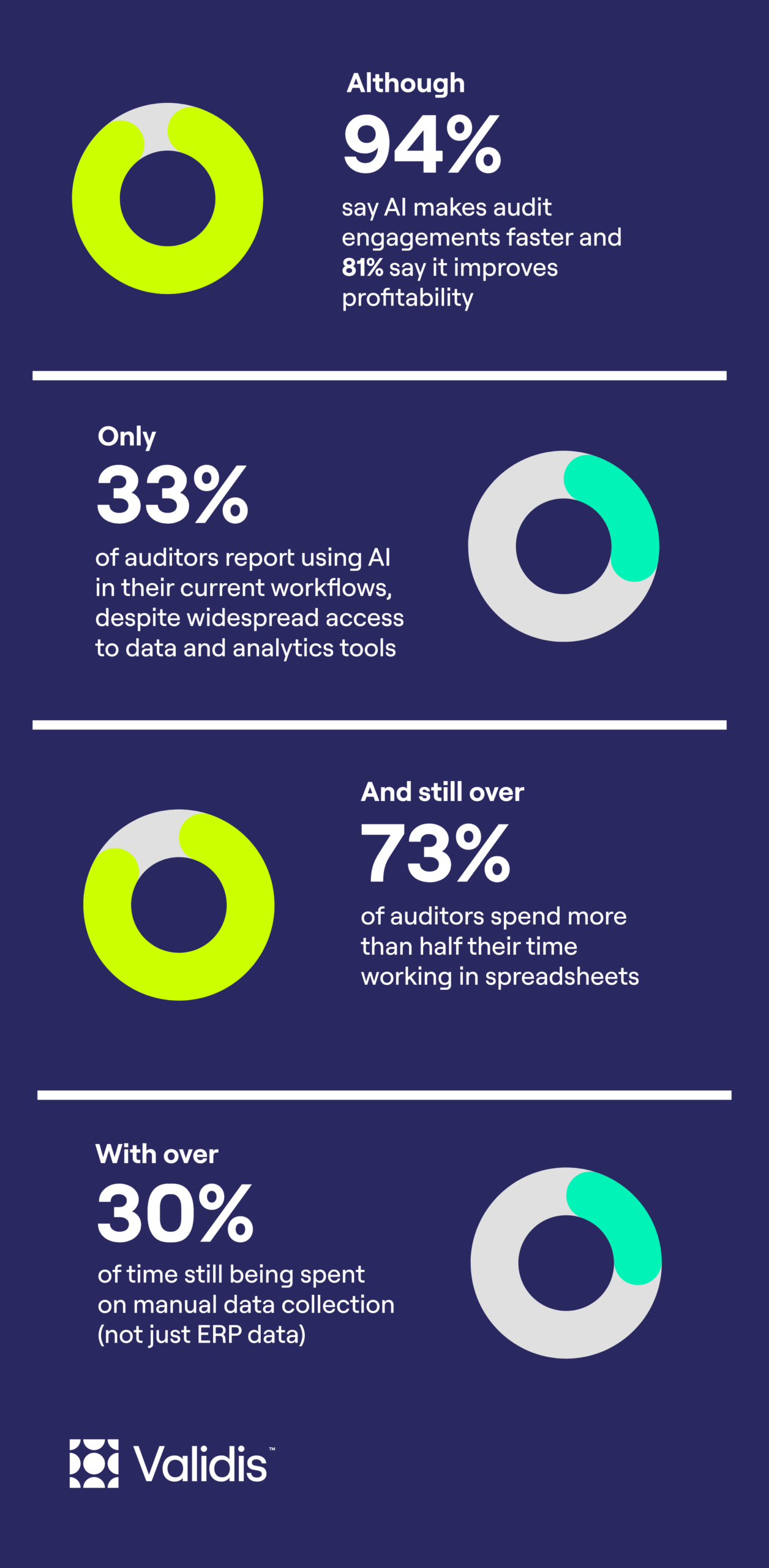
- 88% of audit teams are still handling data manually, not because AI isn’t available, but because adoption hasn’t reached the front of the workflow, where the most time-intensive work actually lives.
- The average audit is 300-400 hours of work and data collections (not just ERP data) is 30-40% of this.
- 90% report that AI reduces errors, yet manual work remains a core part of daily audit activities.
⏭️ Technology Speeds Work but Doesn’t Eliminate Manual Prep
- 94% say AI makes audit engagements faster and 81% say it improves profitability – yet 88% still rely on manual processes because most firms apply AI too late in the tech stack, after data has already been chased, extracted, cleaned, and remapped (meaning the real bottleneck is still inconsistent, non-standardized accounting data – exactly the gap Validis solves).
💻 AI Adoption Varies Widely Across Audit Tasks
- AI adoption in audit is significantly lower than the rest of finance. Only 33% of auditors report using AI in their workflows, compared to 76% of accounting and finance professionals outside audit. A gap that points less to skepticism about AI, and more to the absence of structured adoption within audit-specific workflows.
- Access to tools is not the same as adoption. Most audit teams have some form of automation available. The difference is whether people understand why new processes work, and whether firms have invested in making the transition stick, or simply deployed a tool and moved on.
⏳ Manual and Spreadsheet-Heavy Tasks Consume Significant Time
- 73% of auditors spend more than half their time working in spreadsheets, handling reconciliations, data extraction and manual manipulation.
- 59% of auditors spend >5 hours per week on manual data extraction from unstructured sources like PDFs.
⛔ Data Quality & Integration Remain Obstacles
- Fieldguide and industry commentary identify poor data quality, inconsistent labeling and integration gaps as major barriers that slow automation and AI projects — even after pilot adoption.
👍 Audit Teams Trust AI’s Potential
- 77% cite poor data as a barrier, 60% believe AI will reduce workload. Auditors trust that AI can reduce manual workload and streamline audit work, even as challenges around governance and data transparency remain.
➡️ Industry Shift Toward Digital Audit Methods
- Audit technology frameworks (e.g., from vendors like Inflo) emphasize integrated data ingestion, full-population analytics, and end-to-end digital audit workflows to modernize audit execution.
What surprised us
Many firms are not far from meaningful improvement. The biggest gains are rarely achieved by adding more tools. They come from removing variation in inputs and standardizing the data foundation that every downstream workflow depends on.
But the firms making the most progress share something else: they treated process change as a people challenge, not just a technical one. They explained why new workflows worked. They put energy behind adoption. And they accepted that without that investment, even well-designed processes get quietly abandoned for the comfort of same as last year.
What this means for audit leaders in 2026
Audit resilience will be defined by repeatability. But repeatability is not just a data problem. It is a change management problem. Standardizing your data foundation matters, and so does ensuring your team understands why it matters and how to sustain it through the pressures of busy season.
If you want calmer busy seasons, stronger leverage of talent, and credible progress on AI, start with consistent, audit-ready data across your portfolio. Then put the same energy into adoption that you put into implementation. Everything else becomes easier once both the foundations and the habits stop shifting under your feet.

🕒 3-minute read
Or use the navigation panel on the left to jump straight to the section most relevant to your team.
The State of Audit Data in 2026
Same standards. Very different data realities.
Audit methodology has matured. Audit data has not matured at the same pace. Two engagements can follow the same standards and still begin from radically different starting points, depending on the client system, export quality, chart of accounts structure, and how data has been maintained over time.
How audit data is sourced today
Most firms operate with a mix of approaches across their client base. Some clients provide clean exports with reliable structures. Others supply partial extracts, inconsistent formats, or data that requires reconciliation before it can be trusted. This creates an uncomfortable truth: the audit is often “standard”, but the data is not.
- Manual sourcing: email attachments, spreadsheets, ad hoc exports, and repeated clarification cycles.
- Semi-automated sourcing: tools assist with extraction or mapping, but still require heavy intervention to normalize.
- Standardized sourcing: consistent, structured datasets that align to a repeatable audit workflow across clients.
Consistency remains the missing layer
Inconsistency shows up in small ways that create big costs. Different naming conventions, varying account structures, missing dimensions, and inconsistent period definitions force teams into manual correction and explanation. This work is rarely tracked as a distinct phase. It is absorbed into “fieldwork”, then blamed on “busy season”.
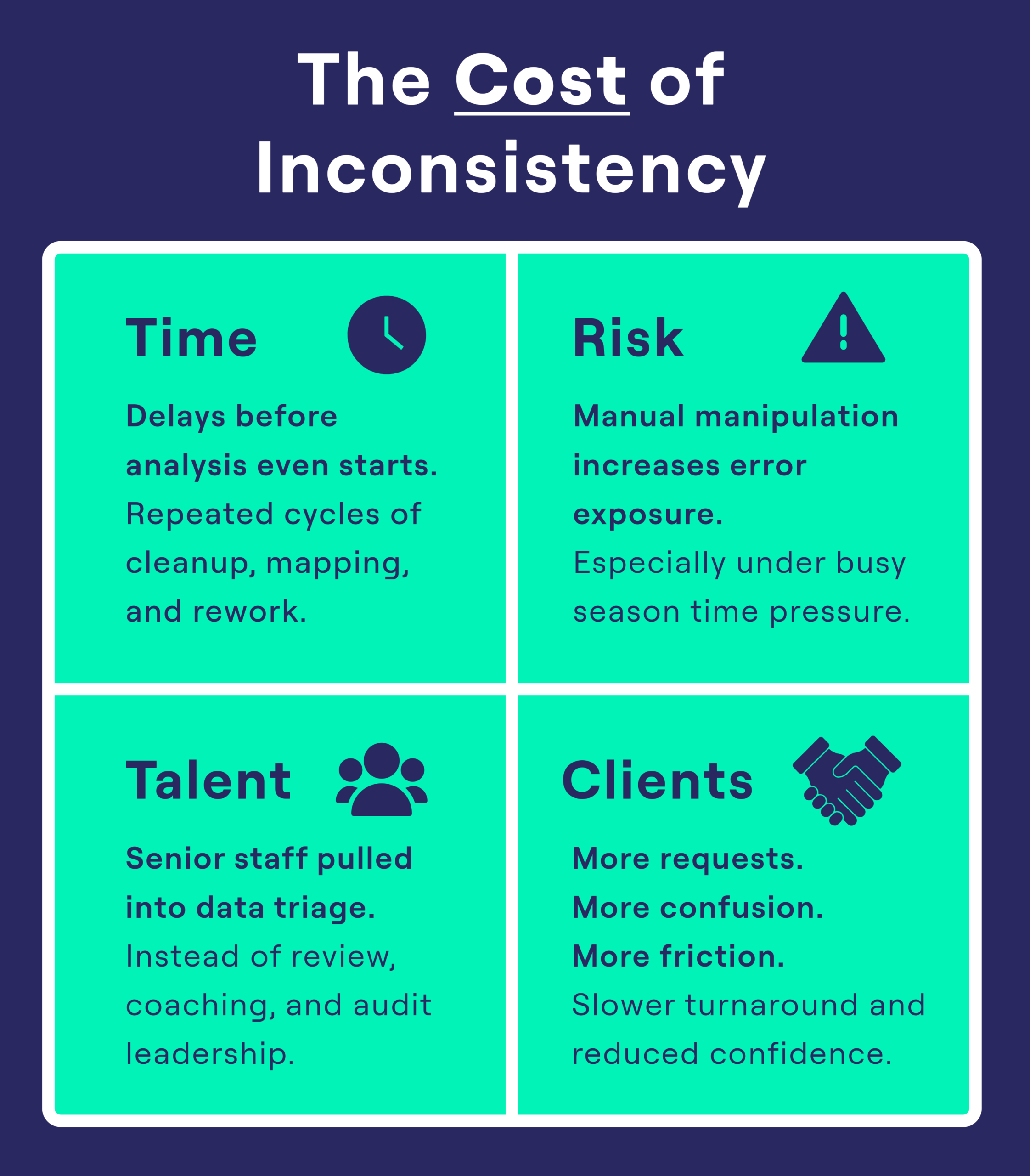
The cost of inconsistency
- Time: delays before analysis can start, plus repeated cycles of cleanup and rework.
- Risk: higher chance of errors when teams manually manipulate data under time pressure.
- Talent leverage: experienced staff pulled into data triage instead of audit leadership.
- Client experience: more requests, more confusion, more friction, and slower delivery.
What the data tells us
Firms often believe they are “mostly automated” because they have adopted tooling in parts of the workflow. The reality is that the workflow still depends on bespoke, engagement-specific fixes. That gap between perceived automation and actual repeatability is where capacity disappears.
Busy Season Pressure Points
Where time is really lost
Busy season failure rarely looks dramatic. It looks like lots of small delays that multiply across a portfolio. One client exports late. Another sends incomplete data. A third changes their chart of accounts. Review gets pushed. Teams work weekends. None of it is unique, and that is the point.
Prep starts earlier, pressure peaks harder
Many firms now feel the pressure shifting forward. What used to be a February or March crunch is increasingly influenced by decisions and readiness in November and December. When the first datasets arrive, the outcome is often already determined by how repeatable your data intake process is.
The hidden time drain in audit delivery
Data issues do not sit neatly in one stage. They leak into planning, fieldwork, review, and client queries. When inputs are inconsistent, teams spend time interpreting rather than analyzing. They validate basic totals instead of testing risk. They chase missing fields instead of concluding faster.
- Time lost before analytics can start
- Time lost correcting mappings and structures
- Time lost explaining anomalies that are really formatting problems
- Time lost in review resolving avoidable questions
Why busy season still feels bespoke
Many firms accept variation as inevitable, then build heroics into the operating model. But bespoke data handling is not a badge of expertise. It is a scalability ceiling. The more clients you serve, the more variation you absorb, and the more your team becomes a data clean-up function.
Assess your busy season readiness and identify where your team is losing time.
Book a Demo
The Automation Gap
Why tools have not delivered scale
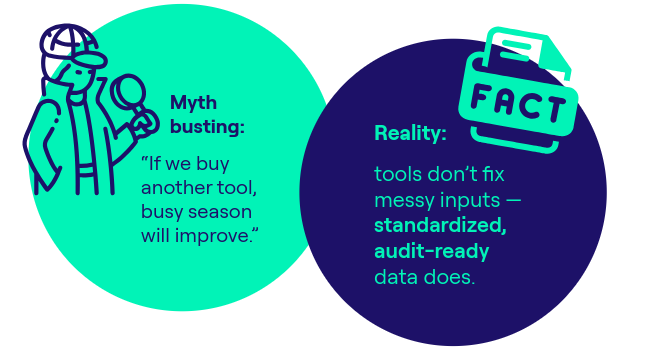
Many firms have invested in automation, but still feel the same seasonal pain. That is not because automation “doesn’t work”. It is because automation is often applied to steps, not to inputs. If the data is inconsistent, automated steps simply move the problem downstream.
Task automation vs data standardization
Task automation can speed up specific actions. Data standardization reduces variation so that the entire workflow becomes repeatable. In practice, firms need both, but standardization must come first. Otherwise, every engagement becomes a custom configuration exercise.
Where automation breaks at volume
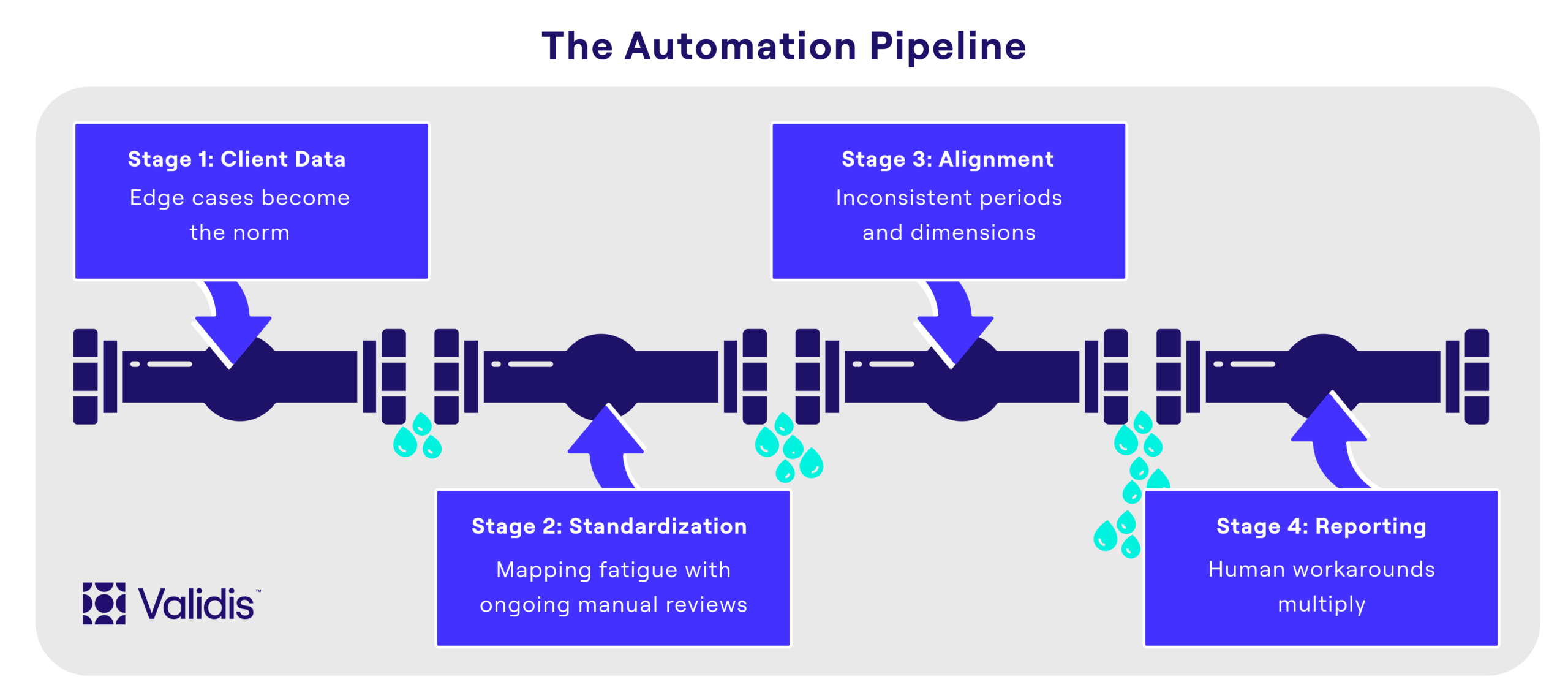
- Edge cases become the norm: with enough clients, you always have exceptions.
- Mapping fatigue: different account structures force ongoing manual mapping and review.
- Inconsistent periods and dimensions: teams spend time aligning data before they can trust it.
- Human workarounds multiply: people build spreadsheets to bridge gaps, and those become dependencies.
What actually scales
Scale comes from repeatable starting points. When you can rely on consistent, audit-ready datasets, you can standardize analytics, accelerate planning, reduce rework in review, and improve consistency across teams. This is the foundation that makes automation meaningful.
Want to see what audit-ready data looks like in practice?
Explore how Validis standardizes client data in minutes — so your team can spend busy season auditing, not cleaning spreadsheets.
Learn More
Audit Teams vs Audit Data
The growing capability mismatch
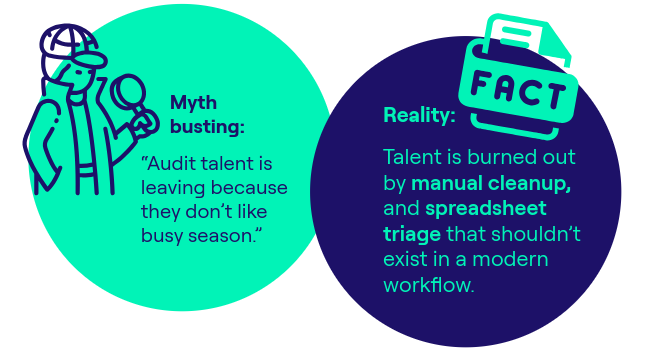
Audit talent is under pressure, but the real issue is how that talent is used. When data arrives inconsistently, teams spend time on interpretation and correction. That work does not build professional judgment, and it does not create client value. It creates fatigue.
Where people are doing the wrong work
In many teams, the most capable people become the fallback for data problems. They are the ones who understand the systems, the mappings, the quirks, and the shortcuts. That might feel efficient in the moment, but it is expensive. It centralizes knowledge, slows throughput, and increases dependency on a few individuals.
Data complexity is outpacing capacity
Clients are not simplifying their systems. Data is becoming richer, more dimensional, and more varied. Junior staff often lack context to diagnose data issues quickly, and training is difficult when every engagement is different. This leads to a familiar pattern: juniors escalate, seniors fix, review slows.
Why this is becoming a talent issue
- Retention: repetitive clean-up work is demotivating and accelerates churn.
- Development: time spent fixing inputs is time not spent building judgment.
- Burnout: busy season hours increase when teams rely on heroics instead of repeatability.
AI Readiness: Signal vs Noise
What audit leaders are quietly fixing first
AI conversations in audit are accelerating, but the practical blockers are consistent. Most firms do not need more ambition. They need stronger data foundations. Without structured, consistent, traceable datasets, AI projects become experiments that never scale.
What “AI-ready data” really means🔎
- Structure: consistent fields, definitions, and periods.
- Consistency: comparable datasets across clients and engagements.
- Traceability: clear lineage from source to standardized output.
- Access: reliable, timely availability so teams can act early.
Why most firms are underprepared
Many teams have pockets of good data and pockets of chaos. That unevenness makes it hard to operationalize anything at scale. You end up with pilots that work for a subset of clients, and exceptions that consume all the time.
The real blockers to AI adoption 🚫
In practice, the barrier is not model capability. It is the readiness of the underlying data. If your data intake process is inconsistent, AI will not save you. It will simply highlight the inconsistency faster.
AI reality check: If your dataset changes shape every time, your AI project becomes a rework project.
Standardize your inputs first — and make AI scalable with audit-ready data.
The 2026 Audit Readiness Framework
Where firms sit today, and where they are heading
This framework helps audit leaders identify their current state and the most effective next move. It is not about perfection. It is about moving from fragile, engagement-specific processes to repeatable foundations that make busy season predictable.
Stage 1: Reactive
Signals: data arrives late and inconsistently, teams fix issues as they go, outcomes depend on heroics.
Impact: high rework, slow review, inconsistent client experience.
Stage 2: Stabilizing
Signals: some standard steps exist, but exceptions still dominate; tooling is present but consistency is limited.
Impact: marginal improvements, but busy season still feels volatile.
Stage 3: Standardized
Signals: repeatable data intake, consistent datasets across most clients, less mapping and correction work.
Impact: faster start to analysis, smoother delivery, improved leverage of teams.
Stage 4: Scalable
Signals: audit-ready data is consistent by default; analytics and workflows are repeatable across portfolio; review becomes more predictable.
Impact: calmer busy seasons, better margins, stronger talent retention, credible foundation for AI and advanced analytics.
Why most firms stall
Firms often invest in tools before fixing the foundations. That creates progress in isolated parts of the workflow, but not in end-to-end delivery. The fastest route forward is usually to reduce variation in inputs, then scale automation and analytics on top of that stable base.
Benchmark your firm’s audit data maturity — and uncover your highest-impact next step with the ROI Calculator.
What This Means for Audit Leaders
Priorities for the year ahead
In 2026, audit leaders will be judged on more than delivery. They will be judged on resilience, predictability, and their ability to do more without burning people out. The quickest path to that outcome is not a new methodology. It is removing the friction that slows every engagement before the real audit work begins.
What to fix first
✅ Make data intake repeatable across your client portfolio
✅ Reduce mapping and structure variability
✅ Create consistent datasets that support standard analytics and review
What to stop over-investing in
❌ Bespoke workarounds that only work for a single client
❌ Manual spreadsheets that become hidden dependencies
❌ Automation applied on top of inconsistent inputs
What readiness looks like in practice
- Earlier confidence in planning and risk
- Fewer data-related questions in review
- More time spent on judgment and client insight
- Less reliance on heroics during busy season
Talk to an audit data specialist about making audit-ready data consistent across your portfolio.
External Sources: DataSnipper, State of AI in Audit & Finance Report (datasnipper.com/ai-report); Fieldguide, AI Adoption Paradox Report, November 2025 (fieldguide.io/blog/press-release-ai-adoption-paradox); Trullion, State of Audit Efficiency Survey and Finance and Accounting Forecast Survey, Q4 2024 (businesswire.com/news/home/20250115900719/en).