

By the time January arrives, it is already almost too late.
Most December year-end clients mean fieldwork opens in January and peaks through February and March. For firms carrying a large portfolio, that window compresses quickly. Teams that spend the first weeks of the year chasing client data are already behind the schedule they set in the autumn.
The firms that go into January with the data already ready do not get that data in January. They get it in planning season.
August and September are the quietest months in the audit calendar. That is the window when preparing for January is not stressful. It is strategic.
Where planning season gets stuck
The standard planning workflow is well-understood: update the risk assessment, issue PBC lists early, run preliminary analytics, compare un-audited balances against prior year. The logic is sound. The execution is where most firms lose time.
Inconsistent or unclear PBC requests lead to misinterpreted responses. Clients send wrong reports, pull wrong date ranges, or omit fields they did not realize were needed. In many cases, the audit team is already two or three request rounds in before the right data arrives. Those rounds take weeks when the audit calendar is tight.
The problem is not client willingness. It is the absence of a standardized intake process. Every client runs a different accounting system. Every system exports financial data in a different structure. A trial balance from QuickBooks looks nothing like a trial balance from Sage or NetSuite. Without a layer that standardizes that data at source, every engagement starts with a reconciliation exercise before any audit work can begin.
For audit firms handling multiple large multi-entity clients, that problem multiplies. By February, when teams hit full capacity, the overhead from data chasing can consume the time that should be going to fieldwork.
Planning season exists to prevent exactly this. Getting the data in now, while there is time to work through edge cases and difficult extracts, means January starts with analysis rather than collection.
Read next: See what audit-ready data looks like before January. Audit and Assurance — Validis — GL, TB, AR and AP from any accounting system, standardized and ready
Five moves before January
The planning playbook that works is straightforward. Done in the quiet months, January starts with the data already in.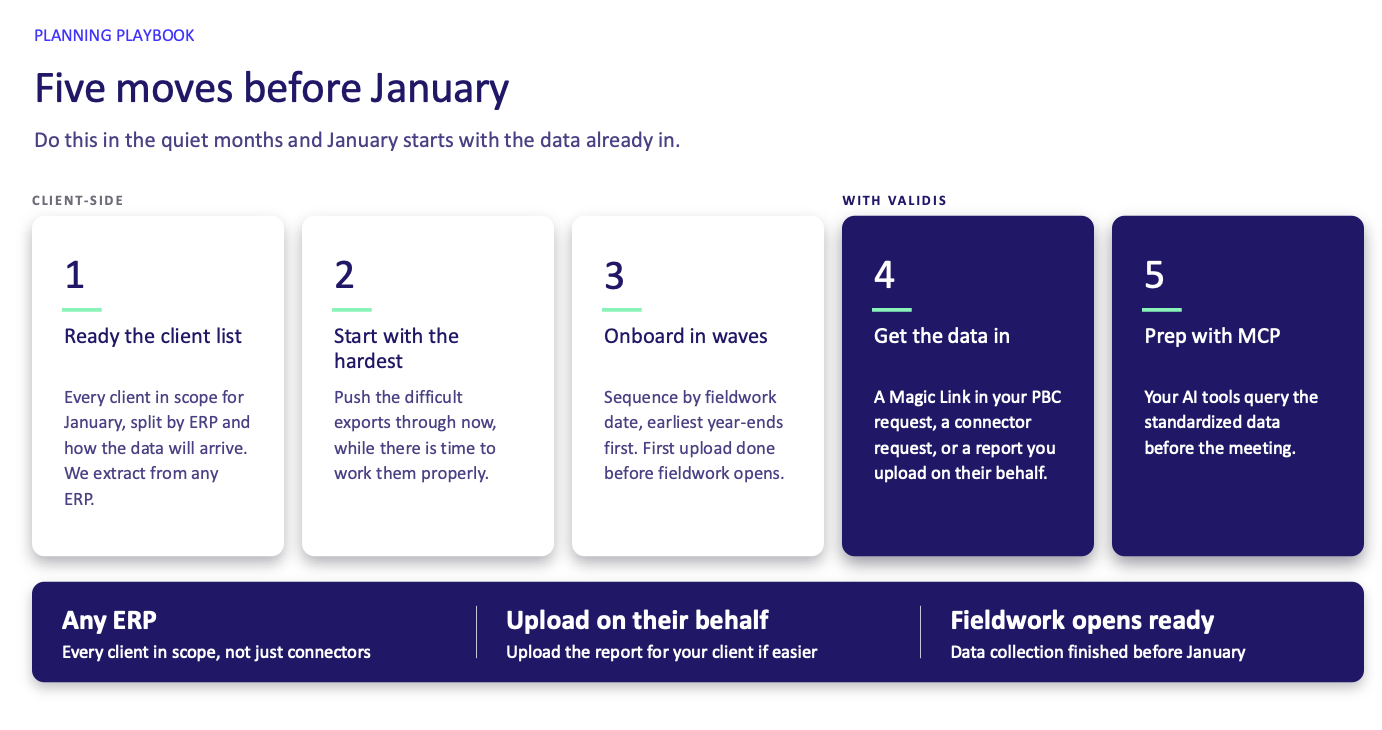
Client Side
1. Ready the client list: Every client in scope for January, split by ERP and how the data will arrive. Knowing which clients run legacy on-premise systems and which run cloud accounting is the first step to sequencing the work.
2. Start with the hardest first: Push the difficult extracts through now, while there is time to work them properly. Clients with unusual ERP configurations, multiple entities, or inconsistent chart of accounts structures take longer to get right. Starting in August means those problems surface with months to resolve, not days.
3. Onboard in waves: Sequence by fieldwork date, earliest year-ends first. The first upload done before fieldwork opens means the planning meeting can start with data on screen rather than a data request outstanding.
With Validis
4. Get the data in: A Magic Link in a PBC request, a direct connector request, or a report uploaded on the client’s behalf. The path depends on what works for each client. All three options end in the same place: standardized, audit-ready data that does not need reformatting.
5. Prep with MCP: Once the data is in, AI tools can query the standardized dataset before the planning meeting. Preliminary analytics, ratio trends, and variance flags are ready before the team sits down with the client.
Read next: See how other firms are getting the data in before January. Why Citrin Cooperman and Withum won’t run an audit without Validis x Caseware — two US firms, one approach to data collection
Making data collection frictionless for clients
The biggest single factor in whether planning data arrives on time is how easy it is for the client to share it.
Validis handles any ERP, any file. Clients running QuickBooks, Sage, NetSuite, Xero, Microsoft Dynamics, or any on-premise system can share data through the same path. Where a direct connector exists, the client authenticates once and data flows automatically. Where it does not, an Excel or CSV export from any ERP drops directly into the engagement.
Magic Links remove the login friction entirely. A link embedded in a PBC request or sent by email takes the client directly to their upload page. No account required. No portal sign-up. One click to the upload.
For clients where getting data out is genuinely difficult, or where their team does not have the time to run the export, the audit firm can upload on their behalf. The firm runs the report from the client’s system and uploads it directly. The client receives a notification. The data is in.
That combination, any ERP, one-click sharing, upload on behalf, is why audit teams that use Validis for planning season save 8+ hours per engagement. Those hours come from eliminating the iteration on PBC requests, the reconciliation of inconsistent exports, and the back-and-forth that delays the start of real audit work.
Read next: Walk through your client list. Book a planning session with the Validis team — a quick session to get your portfolio data-ready this planning season
Using planning season to prep your AI tools
One of the underused advantages of getting client data into Validis during planning season is what it makes possible for the AI tools your team already uses.
Once a client’s data is in, your AI tools query the standardized dataset through Validis MCP before the planning meeting. The AI narrates. Validis calculates. A prompt asking for material changes in the financials, quarter-on-quarter P&L variances over 20%, manual journals posted in the last five days of each period, or a reproducible random sample of GL transactions runs against the actual engagement data.
This is what the planning meeting becomes when the data is in before the meeting. Not a discussion of what the client will provide. A discussion of what the data already shows.
For large multi-entity clients, this is where the planning investment pays back most clearly. Getting that data in during August or September means the planning conversation in October or November starts with preliminary analytics already run. Risk areas are identified before fieldwork, not during it.
Read next: Connect your AI tools to the planning data. Validis MCP — trusted financial data for AI workflows — one sign-in, read-only, audit-logged, under five minutes
The capacity argument for large multi-entity clients
For firms carrying large multi-entity engagements, the capacity argument for planning season preparation is straightforward.
Audit teams reach full capacity by February. For a multi-entity client with four or five legal entities, each requiring separate data extraction and standardization, the overhead of getting data in during January is not a minor inconvenience. It is a capacity event that can delay the entire engagement.
Getting that data in during planning season converts a January capacity problem into a planning season task. The entities are connected, the data is standardized, and any mapping issues across different entity ERPs are resolved in October rather than in the middle of fieldwork.
Planning season is not additional work. It is redistributing work to the time when it costs less.
What this looks like in practice
Stephen Panfile, Senior Manager at Withum, described the operational case clearly: if we can save five minutes on a task for every single audit, that is hundreds of thousands of dollars in WIP saved. The same principle applies to data collection in planning season. The time saved is not the time spent getting the data in. It is the time not spent getting the data in during January, when every hour is already committed to something else.
Andrew O’Donnell, Manager at Citrin Cooperman, framed the adoption argument the same way: if you hesitate, someone else won’t, and they’ll be more efficient and more effective than you. That is true in planning season as much as it is in busy season. The firms that go into January with the data ready are not working harder. They are starting earlier.
Walk into January with the data ready.
Resources
- CPA Practice Advisor: the case for standardizing audit data intake before busy season hits (June 2026)
- Trullion: when is busy season for accountants? breakdown by role (June 2026)
- Why Citrin Cooperman and Withum won’t run an audit without Validis x Caseware
- Accounting Today: four practical shifts to survive and thrive in the busy season (March 2026)