

Every audit needs data from the client. Getting it to you costs them time and effort that never shows up on an engagement budget, and over time it costs the relationship too. This piece sets out where those costs come from, why they are biggest for groups with several entities, and how to take them off your client before this year’s requests go out.
Who actually receives the request
The last two editions of Tomorrow’s Audit looked at planning season from the firm’s side. Last month’s worked backwards through the engagement list. This one looks at it from the client’s side.
Your data request doesn’t go to an audit team. It goes to a finance team, and yours is rarely the only request they have. Lenders, tax advisors and sometimes a parent company or an investor all want the same general ledger, each on their own schedule.
It also lands at a busy time. The finance team is closing its own year, building next year’s budget and reporting to its board. The audit matters to them, but they didn’t set the timetable, and nobody there is judged on how smoothly it goes.
The costs your client is carrying
From the client’s side, a typical request comes with three costs. None of them is billed. All of them are paid, in time.
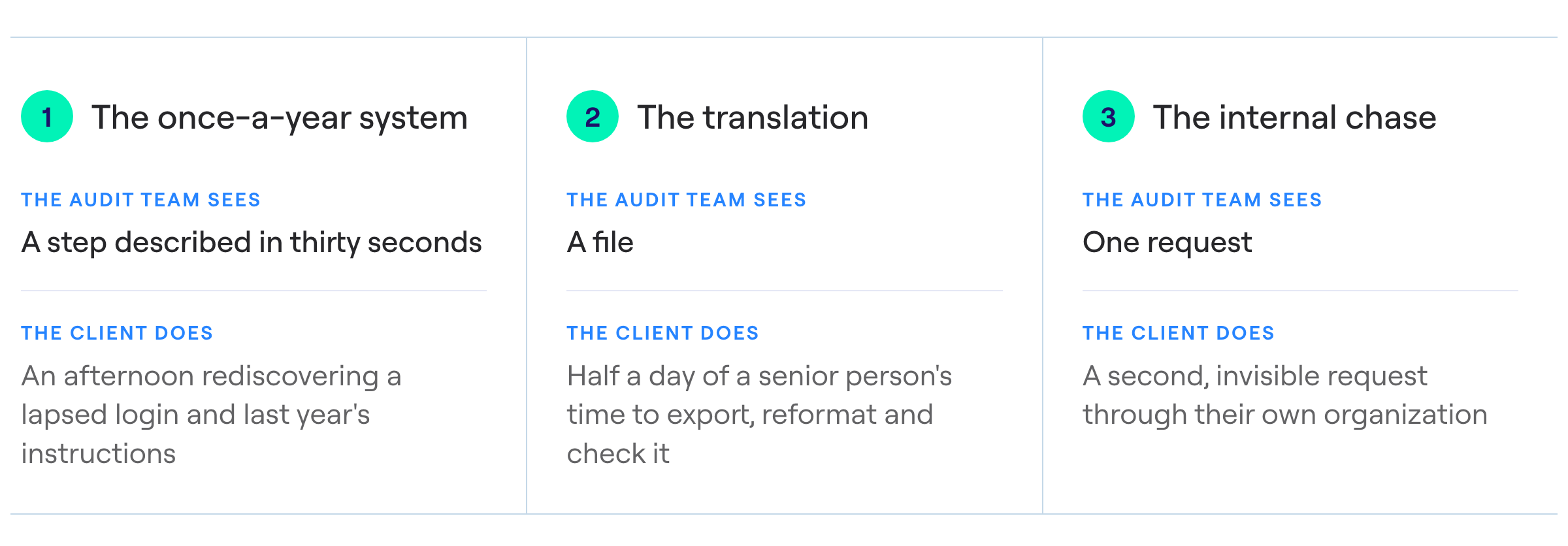
Finding the login
If sharing data means logging into a system, the client logs into it once a year.
By the time your next request arrives, the password has expired, the person who set up the account may have left, and the instructions are buried in last year’s inbox. A step your team can explain in thirty seconds can take the client an afternoon to work out again, every year.
Chasing it internally
The person who gets your request is often not the person who has the data.
So the finance director passes it on to a systems administrator, a colleague at a subsidiary or an outside bookkeeper. Your one request turns into a second request inside the client’s business, with its own delays. Your team only ever sees the first one.
Doing it at the worst time
Your request arrives on top of the client’s own year-end. It is usually answered by the one person who knows where everything lives, and that is the same person the client needs most for its own close. Every hour spent on your request is an hour taken from their own work.
Why it is harder for groups
For a client with several entities, every one of those costs repeats for each entity.
Each entity can run its own accounting system, with its own login and its own person who knows how to get the data out. Some are looked after by a separate finance team, some by an outside bookkeeper. Before the group can send you anything, someone at the center has to ask every entity for its files, chase the ones that are late, and pull them all together.
The more entities there are, the longer that takes, and the more likely it is that one of them holds up the rest. A step that is a minor irritation for a single-entity client becomes a small project for a group. And groups tend to be the biggest engagements on the list, the ones that take longest to collect data for in any case.
What it costs the audit team
Files arrive late. Part of the ledger arrives with a promise of the rest. Each entity’s files come in whatever format its system exports, and the audit team is left to clean them up into something usable. Every gap means a follow-up, and the client pays the same costs again to answer it.
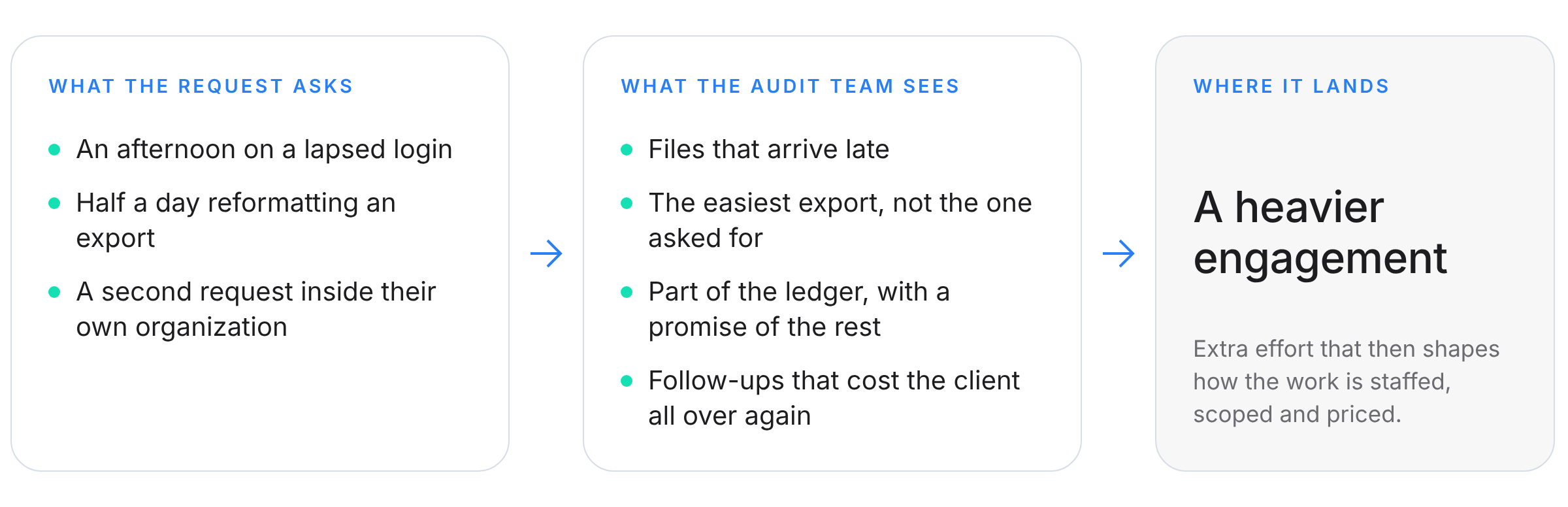
Over time, these engagements start to feel heavier than they should. That weight then shapes how the work is staffed, scoped and priced.
Worth knowing. The friction usually comes from the request, not the relationship. When a request asks more of the client than it needs to, both sides pay for it on every engagement.
Keep the client relationship at the center
The ideal version of data sharing is simple. The client shares access, the data comes straight from source, and there is very little back and forth.
In practice, some clients won’t engage, some are slow, and some you would rather not push. For those clients, the best request is the one that asks them for as little as possible. Sharing data with Validis is now about as easy as it gets, and each route takes something off the client’s side:
- Upload the file you already have. Validis doesn’t need a direct connection to the client’s accounting system. If the GL and TB already reach you by email or as an export, upload them to Validis as they are. You get standardized data back, and the client does nothing differently.
- When you do need to ask, make it one link. With Magic Links, the request sits inside the PBC list the client is already working through. One link, no new account and no password.
- Take the cleanup off your team too. Validis takes any file from any accounting system and standardizes it, so files from different entities and systems come back in one consistent format, audit-ready for Excel, Caseware, Power BI and AI tools like Claude.
That changes the question worth asking in planning season. It is not only “what do we need from this client?” It is “how much of this request does the client actually have to do?”
Count what the request asks the client to do
The exercise is small. Take last year’s request for three or four engagements and read each one as the client will.
Count everything it asks the client to do that is not sending data:
- Accounts to create
- Logins to recover
- Reports to find and export
- Files to collect from each entity
- Hand-offs to a colleague, a subsidiary or an outside bookkeeper
- Follow-ups the client had to answer because the first file was incomplete
That count is the real size of the request. In most firms nobody has ever taken it, because nobody on the audit side experiences it.
Sort the necessary steps from the inherited ones
Then sort every step on the list into one of two groups.
Necessary. The engagement genuinely needs it, and there is no other way to get it.
Inherited. It is there because of how the process was first set up, or because a tool once required it, or because last year’s request was copied forward and nobody asked why.
The inherited steps are the ones worth removing. Each is a cost the client pays every year, and one the firm pays for again in February as a late or partial file.

Start with the clients who pay the most
Not every client needs the same attention. Three groups are worth starting with.
Groups with several entities. Every step you take out of the request is taken out once for each entity, so this is where a simpler request pays back most.
Clients whose data arrived late or partial last year. The lateness is usually a sign of a costly request rather than a lack of goodwill.
Clients where one person carries every request. If the same senior person answers the audit, the lender and the tax advisor, every step you remove gives time back to the person the client can least spare.
Ask one client
The fastest way to see the request from the client’s side is to ask someone who sits there.
Pick one client you have a good relationship with and ask a single question before the requests go out: what was the hardest part of getting us your data last year? Most clients will answer honestly, because nobody has asked before. The answer is usually not the step the audit team would have guessed.
Why planning season is the moment, for the client too
Planning season is usually argued for from the firm’s side: capacity is available now and will not be in February. It is just as true from the client’s side.
For most clients with a December year-end, the close has not started yet. A simpler way to share data, introduced now, makes next quarter easier for them. The same change introduced in January is one more thing to learn in the busiest weeks of their year, and it will be received that way.
What this looks like in practice
A manager takes last year’s request for a handful of engagements, starting with the groups, and lists every step it asked of the client.
Each step gets marked necessary or inherited. The inherited ones come out of this year’s request, or are replaced by a route that asks less of the client, such as uploading the file the team already has.
One client gets one question about what was hardest last year, and the answer goes back into the request before it is sent to everyone else.
None of that is a project. It is an afternoon spent reading the request from the client’s side of the desk.
Your client will never read the workpapers. The request is the part of the audit they actually see, and it is worth designing like it.
Where Validis fits
If you are already a Validis customer, your account manager can go through last year’s engagements with you, starting with your groups, and work out which route fits which client.
If you are not, the Modern Audit Data Hub is the place to start.